
'The biggest near-term risk to Indian equities is the outflow of investments to China as tactical trades by foreign investors.'

To boost domestic manufacturing under the Make in India initiative and reduce dependency on imports, the government is expected to announce in the Budget an increase in the minimum local content requirement for public procurement, with certain sectors being granted exceptions. Currently, firms producing goods, services, or works with at least 50 per cent local content are classified as Class-I local suppliers and are preferred the most in government procurement.
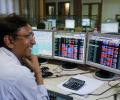
Benchmark BSE Sensex and Nifty snapped their two-day losing streak to close nearly half a per cent higher on Tuesday following gains in banking, metal and auto stocks. The 30-share BSE Sensex climbed 257.43 points or 0.44 per cent to settle at 59,031.30. During the day, it hit a high of 59,199.11 and a low of 58,172.48.

First things first: For those wondering if they need to reapply, the answer is no.

From the Sensex basket, Infosys, IndusInd Bank, Bajaj Finserv, Wipro, HCL Technologies, Bajaj Finance, Tech Mahindra, Tata Consultancy Services, and Larsen & Toubro were the major laggards. Titan Company, Hindustan Unilever, HDFC Bank, Maruti, ITC, Power Grid and Reliance Industries were the gainers.

Transiting from "survival mode", which took most of the management time in FY21, the bank has been able to take a long-term view in terms of growth and preparing technology in the past 12 months.

A new mobile banking 'Trojan' virus -- SOVA -- which can stealthily encrypt an Android phone for ransom and is hard to uninstall is targeting Indian customers, the country's federal cyber security agency said in its latest advisory.

Priya Nair tells you how you can use technology to invest better and maximise returns.

At the World Bank Banga will be replacing David Malpass, a former Trump treasury official, reports axios.com. Malpass had already announced that he will resign by July, months ahead of his term expired. "Ajay is uniquely equipped to lead the World Bank at this critical moment in history," President Biden said in a statement. Banga, 63, currently serves as vice chairman at General Atlantic.
After facing multiple outages that irked the regulator, the country's largest private sector lender, HDFC Bank, is revamping its technology infrastructure by making large scale investments, wherein it is bringing new talent, getting into cloud-native stacks, a shift from the traditional monolithic IT infrastructures, and working with strategic partners for better products and services. The bank management is clear that it will do whatever it takes in line with its growth path to ramp up its technology infrastructure.
The bank has decided to embark on a 'Technology Transformation agenda' to provide its customers smoother, faster, and better banking experience.

Edtech firm Unacademy has laid off 250 people across verticals, according to people familiar with the matter, reducing its employee strength by 50 per cent from what it was two years ago. Of those, 100 are from core functions such as marketing, business, and product, while the rest are from sales.
HDFC Bank on Thursday said network outages that led to a regulatory ban on new credit card sales were not due to transaction volumes, and affirmed that it continues to stay in touch with the RBI for restarting the services but giving a timeline for it will be difficult. The bank said it is on its way to creating a new technology architecture for the future as part of the "digital factory" and "enterprise factory" initiative. But, it conceded that outages will continue under the older system though it will be working to minimise the time taken to bring the service back. In December 2020, the RBI took the unprecedented step of stopping the largest private sector lender from selling any new credit cards and also launching new digital services, because of a series of network outages.
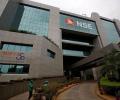
Power Grid was the biggest gainer on the Sensex chart, rising 2.54 per cent, followed by Tech Mahindra, Bajaj Finance, NTPC, UltraTech Cement, Larsen & Toubro, Tata Steel, Bharti Airtel, Bajaj Finserv and HCL Technologies. In contrast, Mahindra & Mahindra, Hindustan Unilever, Infosys and Titan were among the laggards.
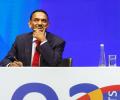
'We are sure FY25 is going to be better...But to call out that all problems are behind us is a bit early.' 'The underlying business sentiment has not changed significantly.'

A delegation of high-level executives from US public pension funds (non-profit and government sectors) is visiting India next week to assess and familiarise themselves with the investment opportunities in the country. These executives belong to various American states and cumulatively represent $1.8 trillion in assets under management (AUM) invested across the US and global markets. The United States (US) mission to India, which includes its embassy and consulates and the Department of Treasury, along with India's Ministry of Finance and the National Investment and Infrastructure Fund (NIIF), is hosting the delegation.

Benchmark equity indices Sensex and Nifty reversed their early gains to close lower on Wednesday due to selling in oil & gas, banking and IT stocks amid weak trends in European markets. The 30-share BSE Sensex declined by 372.46 points or 0.69 per cent to close at 53,514.15, extending its falling streak to a third day. The index opened higher and touched the day's high of 54,211.22 amid gains in Asian markets.
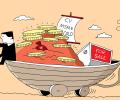
India SME Forum, an organisation for small and medium businesses, has called for creating a dedicated fund of Rs 5000 crore for the export capacity development, promotion, and marketing of Micro, Small & Medium Enterprises (MSMEs) in its Budget recommendation. The forum for MSMEs with over 98,000 members said that to enhance India's global competitiveness and increase its market share in global exports, it was "crucial to increase the number of active exporters and enable at least 3-4 lakh first-time micro, small, and medium exporters while supporting them in promoting Indian products globally."

Terming payment systems as the backbone of a nation's financial infrastructure, N R Narayana Murthy, chief mentor of Infosys, on Wednesday called for widening the reach of the electronic payment system to rural areas.

The market capitalisation of BSE-listed companies jumped to a lifetime peak of Rs 404.18 lakh crore on Thursday helped by a five-day rally in benchmark indices, making investors richer by Rs 11.29 lakh crore. Recovering after a sell-off in early trade, the 30-share BSE Sensex climbed 486.50 points or 0.66 per cent to settle at 74,339.44 on Thursday. During the day, it surged 718.31 points or 0.97 per cent to 74,571.25.

IT services company's CEO outlined an ambitious three-year roadmap to accelerate revenue growth and lift margins.

From the Sensex basket, Kotak Mahindra Bank, HCL Technologies, ICICI Bank, Infosys, Tata Consultancy Services, Wipro, Tech Mahindra and Larsen & Toubro were the major laggards. Mahindra & Mahindra, Nestle, Tata Motors and IndusInd Bank were among the gainers.

Consumers are unlikely to disconnect their mobile connections and will most likely absorb the up to 22 per cent tariff hike imposed last week by Jio, Airtel, and Vodafone Idea (Vi), according to analysts. The last major tariff hike in 2021 was followed by a 4-5 per cent SIM consolidation, with people leaving mobile operators with more expensive plans for their peers offering comparatively affordable options.

'We are confident that over the next few years the government will strike a fine balance between populist measures and growth, and manage coalition partners well.'
Eight months after barring the country's largest private sector lender HDFC Bank from selling new credit cards, the Reserve Bank of India (RBI) has lifted the ban, banking sources said on Tuesday. However, the ban on launching new technology initiatives remains, the sources said. In December last year, the RBI had come out with an unprecedented

The size of Reserve Bank's balance sheet increased by 11.08 per cent to Rs 70.47 lakh crore as on March 2024, leading to the highest-ever dividend payout to the government, according to the central bank's annual report. In actual terms, the increase was Rs 7,02,946.97 crore over Rs 63.45 lakh crore as on March 2023.

An analysis by the Securities and Exchange Board of India (Sebi) has revealed that retail traders remain at the wrong end of the stick when it comes to equity derivatives trading. About 93 per cent of them incurred an average loss of Rs 2 lakh (per trader) during the last three financial years. The new report highlights an increase in the loss-making individual investors in futures and options (F&O) to 91.1 per cent in FY24 compared to 89 per cent in FY22.

The top court took note of the submissions of some aspirants that a question related to an "atom" and its characteristics had two correct answers and a set of examinees, who gave one particular answer out of the two correct ones, were awarded four marks.

Bajaj Finserv, Infosys, Mahindra & Mahindra, Tech Mahindra, Hindustan Unilever, State Bank of India and HCL Technologies were the biggest gainers. On the contrary, Asian Paints, JSW Steel, NTPC and Adani Ports were among the laggards.

The senior IPS officer said that 45 percent of cyber financial frauds taking place in the country are originating from the South East Asia.
With the banking regulator lifting restrictions on HDFC Bank's digital initiatives, the largest private sector lender is now girding up to launch a clutch of customer-facing applications (apps), which will act as stepping stones in its journey to morph into a technology (tech)-led bank from a conventional one. Following repeated outages in its digital offerings, the Reserve Bank of India (RBI) had barred HDFC Bank from issuing new credit cards in December 2020 and prevented it from going ahead with its digital launches. The embargo on issuing credit cards was lifted in August 2021 and the ban on digital launches was lifted last week.

'He's at best a holding-CEO. Not one who will re-imagine the bank,' a senior banker and former colleague tells Raghu Mohan about HDFC Bank CEO & MD Sashidhar Jagdishan.

Among the Sensex firms, Wipro jumped over 6 per cent after the IT company's December quarter earnings beat estimates. The other prominent gainers were HCL Technologies, HDFC Bank, Infosys, Tech Mahindra, Bharti Airtel and Reliance Industries.
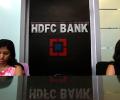
Having issued over 21 lakh cards since lifting of curbs last year, the country's largest private sector lender HDFC Bank is planning to launch a slew of digital initiatives over the next few quarters, a top official said. The Reserve Bank had barred HDFC Bank from issuing new credit cards following incidents of outages in the lender's internet banking /mobile banking/ payment utilities over the previous two years. The curbs were partially lifted after eight months in August last year. Finally, in March 2022, the RBI lifted all restrictions placed on the bank, including digital launches.
Benchmark indices Sensex and Nifty gave up early gains to close lower for a fourth straight session on Thursday due to selling in IT and banking shares amid weak global equities. The 30-share BSE benchmark settled 98 points or 0.18 per cent lower at 53,416.15. During the day, it hit a high of 53,861.28 and a low of 53,163.77. The broader NSE Nifty also pared initial gains and ended 28 points or 0.18 per cent down to settle at 15,938.65.
Among the Sensex firms, HCL Technologies, Tata Consultancy Services, Maruti, Wipro, Larsen & Toubro, Infosys, Tata Steel, Bharti Airtel, State Bank of India, Tech Mahindra, UltraTech Cement and Mahindra & Mahindra were the major gainers.

'When the bombing happened in the Taj Mahal hotel in 2008, that was a very sad moment, but he really took care of the people, took care of everybody and that was when you saw some of his best moments.' 'There are some things which we will never forget. That is when the best of a person comes out.'

Gold seems to be losing its glitter in India due to a rise in prices. Demand in Q2CY24 was 149.7 tonnes - a 5 per cent drop compared to 158.1 tonnes in the same period last year, according to a report by the World Gold Council (WGC). Demand by value in April-June 2024 stood at Rs 93,850 crore, up by 14 per cent compared to Rs 82,530 crore in the same period last year.

For Lori Beer, chief information officer, JPMorgan Chase & Co, largest banker in the US, India is a big part of the organisation's global technology footprint and is core to its products and services. This is evident from the fact that in less than two months since JPMorgan & Chase chief executive officer Jamie Dimon visited India, Beer has come here to see the recently opened centres in Mumbai and Bengaluru. "What is different for me this year are our new centres and to be able to come and see the vibrancy, and connectedness is great.
